 EN

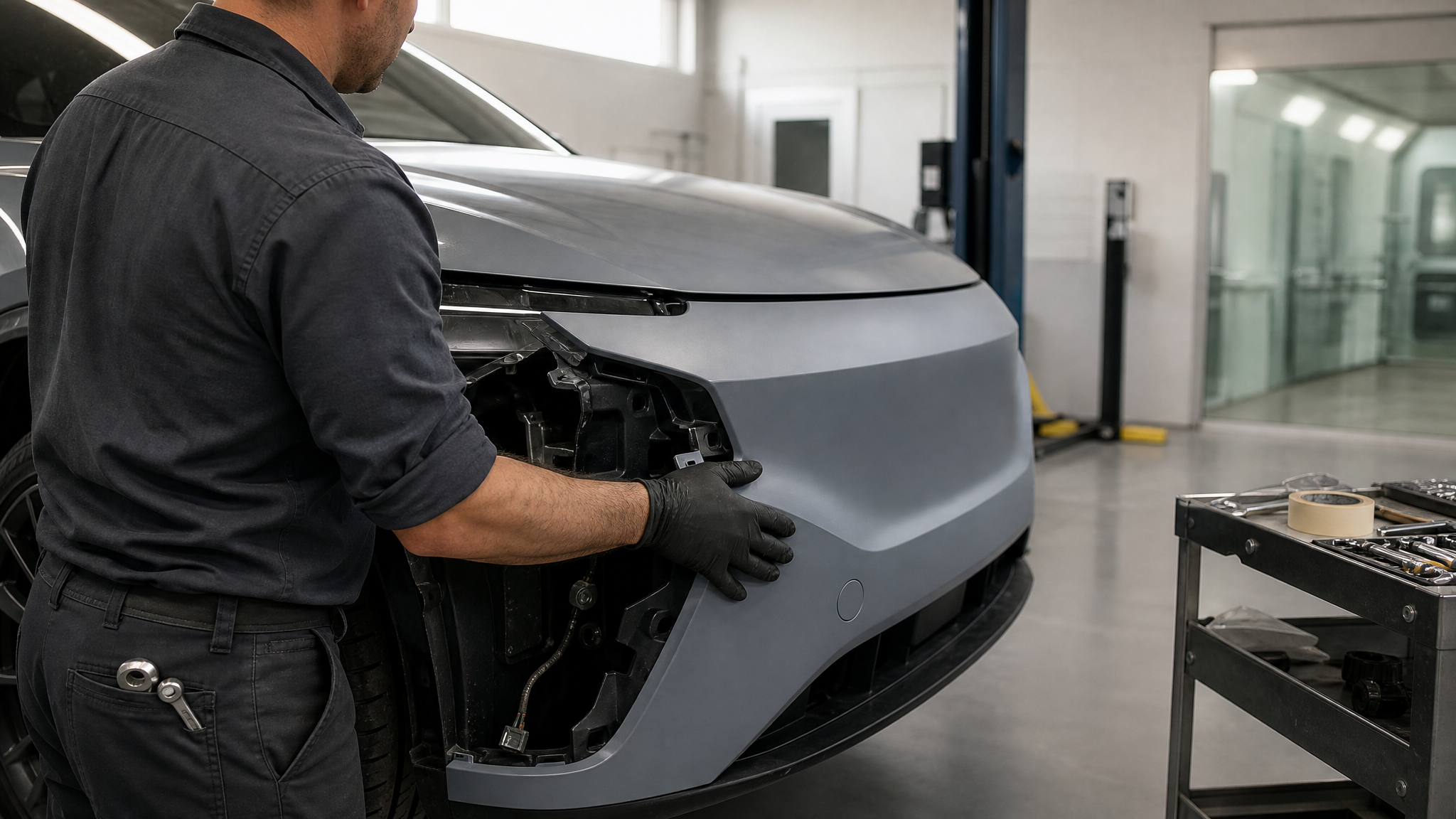
A front-end hit on a two-year-old electric car is now a routine job in Europe, Latin America and Southeast Asia. What is not routine is getting the parts. For Chinese brands, the sales network arrived years before the repair network, and the gap between them is where the aftermarket is being decided.
The Cars Arrived. The Parts Chain Didn't.
When a brand enters a market it builds showrooms, service points and a national parts warehouse sized for warranty work and scheduled maintenance. Collision parts follow a different demand curve: unpredictable, model-mixed, and concentrated on exactly the items that break first. Front bumper covers, headlamp assemblies, grilles, fenders and hoods account for most of a front-end repair.
Outside the dealer chain, that demand lands on independent body shops and the distributors who supply them. Those buyers work from catalogs, and for Chinese models the catalog is thin. Part numbers differ between markets, one platform often carries several front fascias, and the OEM publishes no aftermarket-facing mapping. A shop that cannot identify the part cannot quote the job.
The timing makes it harder to plan. The first wave of these cars is only now reaching its first collision cycle, spread thinly across many markets rather than concentrated in one, so no single distributor sees enough volume to justify a deep catalog.
A Closed Repair Network Answers It, for the OEM
The OEM response has been to build approved networks rather than open the market. BYD's UK operation, for instance, reported launching a network of 138 approved repairers with its partner Vizion, staffed by trained technicians. The model protects warranty quality and keeps repair revenue close to the brand.
It also concentrates volume. For a distributor, an approved list is a finite set of accounts, and every shop outside it is either waiting for access or looking for another source. Insurers have their own interest in this: a single-network repair removes the competing quotes they normally use to control cost and cycle time, which is why parts availability tends to become an insurance conversation rather than a workshop one.
Inside it, parts are bought through the brand's own channel at the brand's prices. Outside, the same repair is priced from whatever the shop can find, usually a used panel or a wait. Two markets running in parallel on the same street, and only one has a catalog.
The Fender Bender Is Where the Money Is
A typical front-end repair on these cars is a bumper cover, a headlamp, a grille and often a fender. Individually unremarkable parts. Together, the reason a car sits in a bay for three weeks.
Owner forums in several markets describe waits measured in weeks for lighting modules and body panels, and a car waiting on parts is a car the insurer is paying a rental on. That cost pressure is the aftermarket's opening, and it is the same opening that existed for Japanese and Korean brands twenty years ago.
Two conditions decide whether a supplier can take it. The first is fitment: a bumper cover listed for an EV front end has to carry the cutouts and brackets for radar and camera units, or it comes back. The second is calibration. Replacing a bumper that houses a radar usually means recalibration, and a shop without the equipment has to sublet the job, which changes the quote before the parts are even ordered.
What Decides the Outcome
Three things separate the suppliers who get this work from those who will not.
Fitment data comes first. Not a printed catalog, but a mapping from OEM number and year range to a sellable SKU, kept current as facelifts arrive. A distributor who has to email for a fitment check twice will stop calling.
Sensor-ready parts come second. Brackets, retainers and cutouts supplied with the cover, so the shop is not improvising at the bench at seven in the evening.
Stock depth comes third. Twenty models held deep beats two hundred held thin, because the distributor's customer is not shopping, they are waiting. A three-day dispatch on a fast-moving cover wins more accounts than a catalog twice the size with six-week lead times.
None of this requires waiting for an OEM to publish anything. It requires the unglamorous work of building the mapping model by model, and that is precisely why the gap has stayed open this long.