 EN

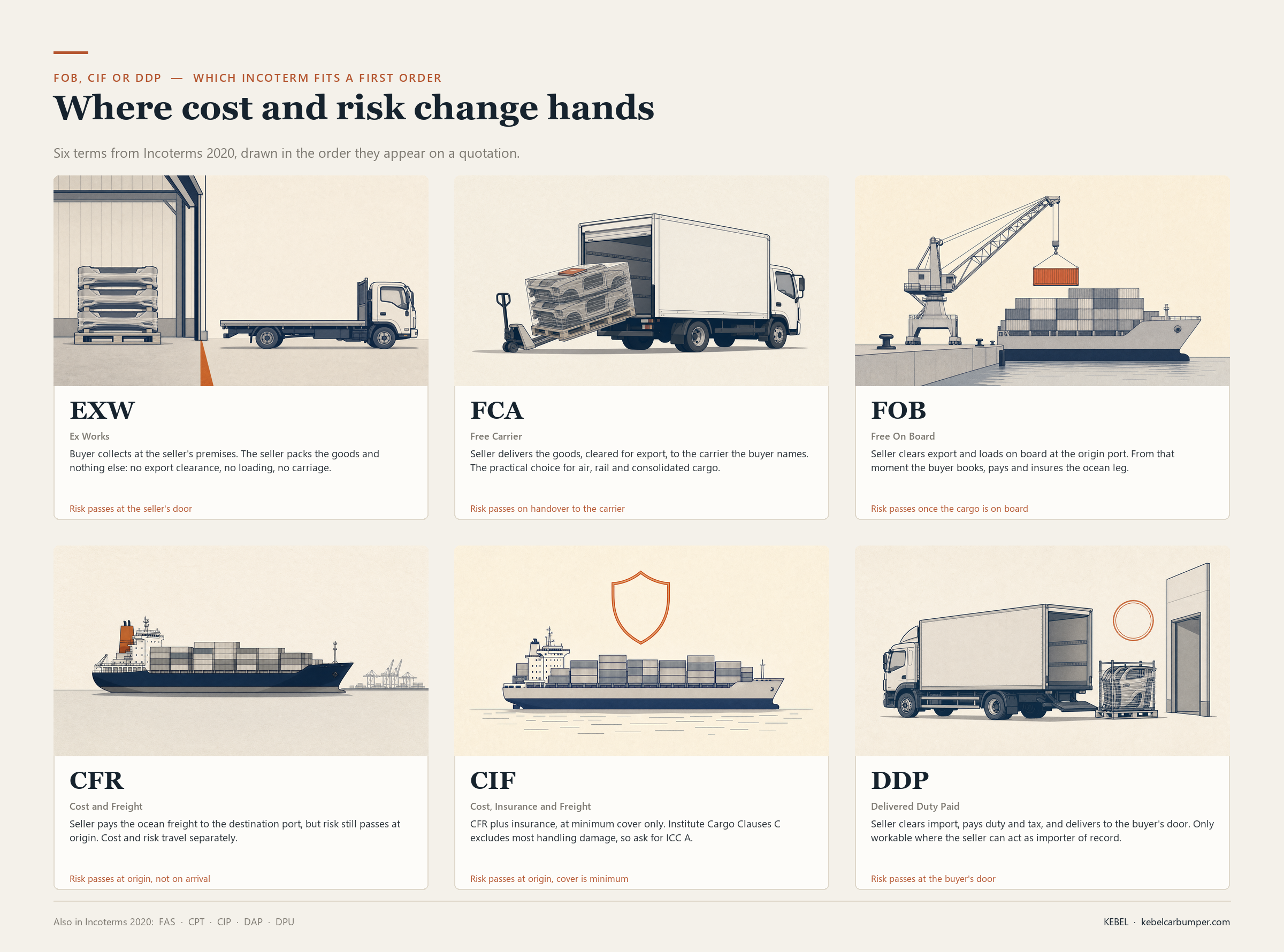
The shipping term on a quotation is not paperwork. It decides who books the vessel, where the risk of loss passes from seller to buyer, and whose invoice the freight and duty land on. On a first order of body panels, the wrong choice usually shows up late, as a destination charge nobody budgeted for or a damaged pallet nobody will pay for.
What Each Term Hands Over
Under FOB, the seller clears the goods for export and puts them on board at the named port. From there the buyer books the main carriage, pays freight and insurance, and handles everything at destination. Risk passes when the cargo is on board. For a buyer who already works with a forwarder, or who consolidates several suppliers into one container, FOB keeps control and makes freight costs comparable between suppliers.
CIF shifts more onto the seller: they pay the ocean freight and insurance through to the destination port. Two things buyers routinely misread here. Risk still passes at the loading port, not on arrival, so the seller is not carrying the cargo across the ocean for you. And the insurance CIF requires under Incoterms 2020 is minimum cover, Institute Cargo Clauses C, which leaves out a lot of handling damage.
DDP goes furthest. The seller delivers to the buyer's door with import cleared and duties paid, and the buyer's only remaining job is unloading. The catch is twofold: in some markets a foreign seller cannot legally act as importer of record, and DDP quotes tend to fold freight, duty and tax into a single figure with no breakdown, which leaves the buyer unable to check whether the duty was classified correctly.
What It Changes on a Body Parts Order
Three things behave differently on bumpers, hoods and lamp assemblies than on dense cargo.
Volume comes first. These parts are bulky and light, so ocean freight is charged on cubic meters or volumetric weight rather than actual kilos, and a 40HQ holds far fewer bumper kits than its tonnage suggests. Under FOB the buyer sees the real freight line. Under CIF or DDP it disappears into the unit price, which is convenient until you try to compare two suppliers and find one has padded freight by a margin you cannot see.
Damage comes second. Body panels and lamp lenses are among the most damage-prone goods in a container, and the minimum insurance attached to CIF is narrow. A buyer taking CIF should ask the seller to upgrade cover to ICC A and show the certificate, or insure the cargo separately.
Duty classification comes third. Bumpers, grilles, lamps and radiators do not share a single HS line, and the applicable rate changes with the code and the market. Under DDP the seller chooses that code. If it is wrong, the buyer can still face questions from customs at the door, having already paid the seller in full.
How to Choose for a First Order
Three situations, three answers.
If you have no forwarder, one supplier and a modest volume, CIF is workable. Ask for a freight breakdown and ICC A cover, and do not treat it as risk-until-arrival.
If you have your own forwarder, or several suppliers to consolidate, take FOB. It keeps freight comparable and lets your forwarder merge containers instead of paying for three separate bookings.
If you want one landed number, DDP is only real when you confirm in writing who will be the importer of record, and get duty and tax shown separately. Where the seller cannot legally be importer of record, DDP is not available, whatever the quotation says.
Four questions settle it before you sign: who books the vessel, where risk transfers, which insurance clause applies, and which duty code will be used. A supplier who answers all four in writing is quoting properly. One who answers "all included" is not.
Send the model list and the destination port, and ask for FOB and CIF side by side. Two terms on the same order tell you more than any single quotation, because the gap between them is where the real cost sits.