 EN

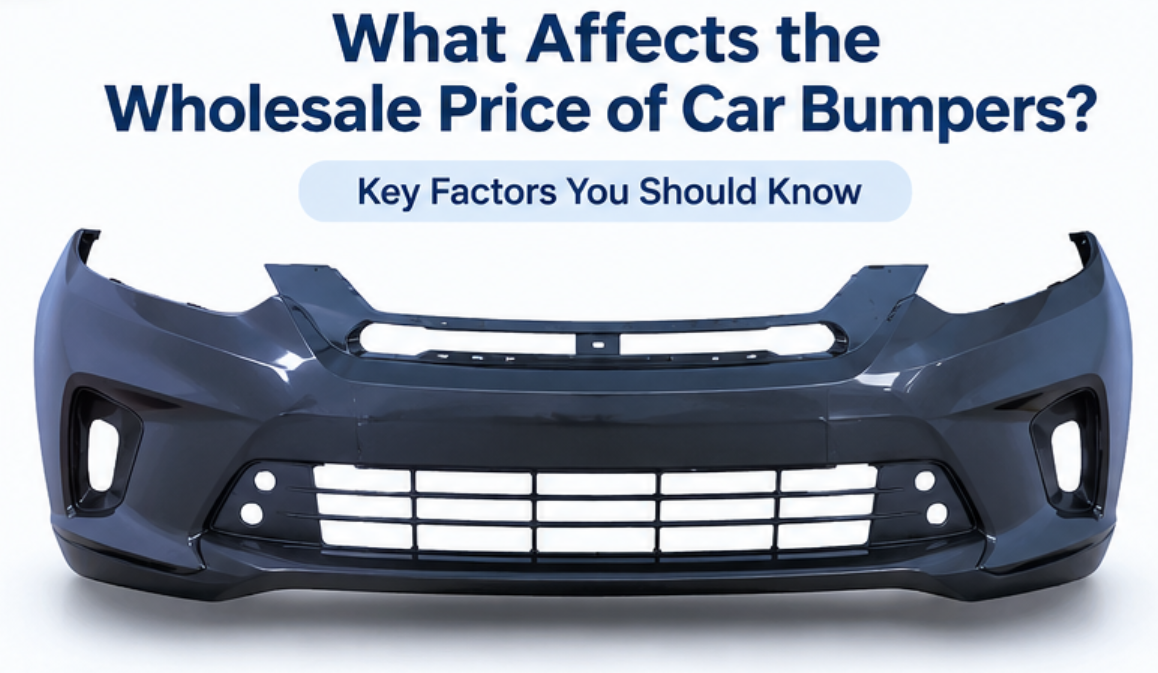
When sourcing car bumpers in bulk, price is often one of the first things buyers consider. However, wholesale bumper prices can vary significantly depending on the vehicle model, material, product specifications, manufacturing process, order quantity, and shipping arrangements.
For auto parts wholesalers, importers, and distributors, understanding these factors is essential for making better purchasing decisions and managing overall sourcing costs.
A lower quotation does not always mean a better deal. Differences in product configuration, fitment, packaging, and delivery terms can make two seemingly similar offers difficult to compare.
In this guide, we explain the key factors that affect the wholesale price of car bumpers and what buyers should consider before placing a bulk order.
1. Vehicle Model and Bumper Design
The vehicle model is one of the most important factors affecting the wholesale price of a car bumper.
Different vehicles require different bumper designs, dimensions, mounting structures, and product configurations. Even bumpers designed for the same vehicle model may differ depending on the model year, trim level, and market version.
For example, a standard bumper cover and a bumper designed for a higher trim level may have different openings, mounting positions, and provisions for additional components.
Several details can affect the product cost:
-
Vehicle make and model
-
Model year and production generation
-
Front or rear bumper configuration
-
Standard, sport, or off-road styling
-
Market-specific design differences
-
Sensor, camera, and fog lamp provisions
Some newer vehicles also incorporate more complex front-end designs to accommodate parking sensors, cameras, radar equipment, and other electronic components.
For buyers, providing accurate vehicle information and OEM reference numbers helps suppliers identify the correct bumper and avoid unnecessary quotation differences.
2. Raw Materials and Material Specifications
The materials used in bumper manufacturing also influence the wholesale price.
Automotive bumper components can be manufactured using different plastic materials, depending on the intended application, design requirements, and manufacturing specifications.
Common materials used in automotive plastic components include:
-
PP (Polypropylene): A widely used thermoplastic in automotive applications. It offers a combination of flexibility, low weight, and practical processing characteristics.
-
ABS (Acrylonitrile Butadiene Styrene): A thermoplastic known for its rigidity, impact resistance, and surface characteristics.
-
TPO (Thermoplastic Olefin): Used in automotive exterior applications where flexibility and impact-related properties are important.
The actual material selection depends on the bumper design and product specifications.
Material costs, material grades, processing requirements, and the amount of material required can all influence manufacturing expenses.
Buyers should avoid comparing bumper prices based only on appearance. Two products may look similar but use different material specifications or manufacturing processes.
When requesting a quotation, it is useful to confirm the material information with the supplier.
3. Manufacturing Process and Production Requirements
The manufacturing process is another factor that affects bumper pricing.
Plastic automotive bumper covers are commonly produced through processes such as injection molding. The production process involves equipment, molds, raw materials, and subsequent finishing operations.
Several manufacturing considerations can influence the final quotation:
Mold and Tooling Requirements
Bumper designs require molds that match the product's shape and dimensions. Mold complexity, development requirements, and tooling arrangements can affect production costs.
For standard replacement products using existing molds, buyers generally do not need to develop new tooling. However, custom designs or new product development may involve additional tooling expenses.
Production Efficiency
Production efficiency, equipment requirements, and manufacturing complexity can influence the cost per unit.
Surface Finishing
Depending on the product specification, additional operations may include surface preparation, primer application, painting, and finishing.
Different finishing requirements can result in different production costs.
For buyers, understanding whether a quotation covers a basic unpainted bumper cover or a finished product is important when comparing suppliers.
4. Product Configuration and Accessories
Not all bumper quotations cover the same products.
One supplier may quote only a bumper cover, while another may offer a more complete bumper assembly with additional components.
Depending on the vehicle and product configuration, a bumper-related order may include:
-
Front or rear bumper cover
-
Upper or lower grille
-
Fog lamp covers
-
Reflectors
-
Sensor brackets or mounting provisions
-
Side brackets and mounting accessories
-
Other decorative or functional components
The exact components included depend on the vehicle application and the supplier's product range.
For example, a bumper cover without additional accessories should not be directly compared with a complete bumper kit containing grilles and other components.
Before confirming an order, buyers should request a clear product list and confirm which components are included in the quoted price.
This helps prevent misunderstandings during order confirmation and delivery.
5. Order Quantity and Purchasing Volume
Order quantity is another important consideration in wholesale purchasing.
In general, larger orders may provide opportunities for more competitive unit pricing because certain production, preparation, and handling costs can be distributed across more units.
However, the actual pricing structure depends on the supplier's production arrangements, product availability, and order requirements.
When requesting a wholesale quotation, buyers should consider:
-
Minimum order quantity (MOQ)
-
Quantity per vehicle model
-
Total order volume
-
Mixed-model purchasing arrangements
-
Repeat order frequency
-
Packaging requirements
For example, an order containing several bumper models may require different production arrangements from an order containing a large quantity of one model.
Buyers who regularly purchase multiple vehicle applications may benefit from discussing a longer-term purchasing plan with their suppliers.
It is also worth asking whether different models can be combined into one shipment to improve purchasing and logistics efficiency.
6. Quality Standards and Product Fitment
Product quality is not determined by appearance alone.
For replacement automotive bumpers, fitment and dimensional accuracy are important considerations.
A bumper needs to match the corresponding vehicle application and mounting requirements. Differences in dimensions, mounting points, openings, and surface finishing can affect installation.
When evaluating suppliers, buyers should pay attention to:
Dimensional Accuracy
The product should follow the intended design dimensions and mounting specifications.
Mounting Position
Mounting points and brackets should correspond to the intended vehicle application.
Surface Quality
The bumper surface should be checked for visible defects, uneven finishing, and other quality issues.
Opening and Accessory Compatibility
Sensor holes, fog lamp openings, grille positions, and other configurations should match the specified version.
Quality Inspection
Buyers can request product photos, inspection information, and available quality documentation before shipment.
Different quality requirements and inspection arrangements may affect the final quotation.
The key is to compare products with equivalent specifications rather than choosing a supplier based entirely on the lowest price.
7. Packaging and Shipping Costs
Car bumpers are relatively large automotive exterior components. Consequently, packaging and transportation can have a significant impact on the total purchasing cost.
Even when the actual product weight is not particularly high, the package may occupy considerable cargo space.
Shipping charges can depend on:
-
Package dimensions and total volume
-
Actual gross weight
-
Packaging materials
-
Shipping destination
-
Transportation method
-
Shipment quantity
-
Freight surcharges and additional services
For air freight and some other transportation services, carriers may calculate chargeable weight using either actual weight or volumetric weight, depending on the applicable shipping rules.
For ocean freight, buyers should also consider whether the shipment is arranged as LCL (Less than Container Load) or FCL (Full Container Load).
Because bumper covers are bulky, packaging design and container utilization deserve attention when planning larger orders.
Buyers should ask suppliers to provide estimated package dimensions, gross weight, and packing information when requesting shipping quotations.
A competitive product price does not necessarily mean a competitive delivered cost.
8. Trade Terms, Customs Duties, and Destination Costs
The trade terms used in a quotation can also make a substantial difference to the final purchasing cost.
For international B2B transactions, buyers may encounter different Incoterms, such as:
-
EXW: The seller makes the goods available at the agreed location. The buyer generally arranges the subsequent transportation.
-
FOB: The seller delivers the goods on board the vessel at the agreed port of shipment, subject to the applicable Incoterms rules.
-
CIF: The seller arranges and pays for the cost, insurance, and freight to the named destination port, subject to the agreed terms.
-
DDP: The seller arranges delivery to the named destination and takes responsibility for import clearance and applicable duties and taxes under the agreed arrangement.
These terms define different responsibilities and cost allocations between buyers and sellers.
Import duties, taxes, customs clearance, destination handling, and local transportation may also affect the total landed cost.
Therefore, buyers should compare quotations using the same trade terms and delivery destination.
A lower EXW quotation should not automatically be considered cheaper than a CIF or DDP quotation.
9. How to Compare Wholesale Car Bumper Quotations
When receiving quotations from multiple suppliers, it is important to compare the same product specifications and purchasing conditions.
The following checklist can help buyers evaluate offers more accurately.
| Comparison Item | What Buyers Should Confirm |
|---|---|
| Vehicle Application | Make, model, year, and version |
| OEM Reference | Correct reference number, where available |
| Product Type | Bumper cover or complete bumper assembly |
| Material | Confirmed material specification |
| Configuration | Sensor holes, fog lamp openings, grilles, etc. |
| Surface Finish | Unpainted, primed, or painted |
| Order Quantity | MOQ and unit price at each quantity |
| Packaging | Package dimensions and protection |
| Quality Control | Inspection standards and available records |
| Trade Terms | EXW, FOB, CIF, DDP, or other agreed terms |
| Delivery | Production schedule and shipping arrangement |
Using the same checklist for every supplier makes it easier to identify differences between quotations.
It also helps buyers avoid unexpected expenses caused by missing accessories, incorrect vehicle applications, or unclear shipping arrangements.
10. How to Get a More Competitive Wholesale Car Bumper Price
Finding a competitive supplier is not simply about negotiating the lowest unit price. A better purchasing strategy involves providing accurate requirements and evaluating the complete supply arrangement.
Here are several practical suggestions for buyers:
1. Provide Accurate Vehicle Information
Include the vehicle make, model, year, version, and OEM reference number whenever possible. This helps suppliers identify the correct product.
2. Clarify Product Specifications
Confirm whether you need an unpainted bumper cover, a primed product, or a complete bumper kit with accessories.
3. Request Tiered Pricing
Ask suppliers to provide quotations for different order quantities. This allows you to evaluate how purchasing volume affects unit pricing.
4. Compare Complete Quotations
Check product specifications, packaging, shipping terms, and additional costs instead of comparing unit prices alone.
5. Build Long-Term Supplier Relationships
Regular purchasing and clear communication can help both parties understand product requirements, coordinate orders, and improve purchasing efficiency over time.
A reliable supplier should be able to explain the product configuration, quotation details, and delivery arrangements clearly.
Frequently Asked Questions
1. Why do wholesale car bumper prices vary between suppliers?
Prices may differ because of variations in material specifications, manufacturing processes, product configurations, quality requirements, order quantities, and packaging arrangements. Different suppliers may also quote different trade terms.
2. Does ordering more car bumpers reduce the unit price?
Larger order quantities may reduce the unit price by distributing certain production and handling costs across more products. However, the actual discount depends on the supplier, product, and order arrangement.
3. Are unpainted bumpers cheaper than painted bumpers?
Unpainted bumper covers generally require fewer finishing operations than fully painted products. However, the actual price difference depends on the product specifications, painting requirements, and supplier's production arrangements.
4. Does the OEM number affect the bumper price?
An OEM number helps identify a specific replacement part and its intended application. Different OEM references may correspond to different designs, model years, or configurations, which can result in different product costs.
5. What is the difference between a bumper cover and a bumper assembly?
A bumper cover generally refers to the exterior bumper panel. A bumper assembly may include additional components, depending on the vehicle and product specification. Buyers should always confirm the included parts before placing an order.
6. What information should I provide when requesting a wholesale quotation?
You should ideally provide the vehicle make, model, year, OEM reference number, required quantity, product configuration, and destination country. Reference photos can also help suppliers confirm the correct product.
Final Thoughts
Wholesale car bumper pricing is influenced by several factors, including vehicle application, raw materials, manufacturing requirements, product configuration, order quantity, quality standards, and international shipping costs.
For importers, distributors, and automotive parts wholesalers, understanding these factors makes it easier to compare suppliers and manage purchasing costs.
Rather than focusing only on the lowest unit price, buyers should evaluate product specifications, fitment, quality consistency, and the complete delivery arrangement.
Working with a supplier that understands automotive body parts and can provide clear product information is an important step toward building a stable sourcing relationship.
Looking for a reliable source of replacement car bumpers?
KEBEL focuses on automotive exterior parts and replacement body components for international B2B buyers. Whether you are sourcing front bumpers, rear bumpers, or other automotive body parts, contact our team with your vehicle applications and purchasing requirements to discuss suitable products and wholesale quotations.
Table of Contents
- 1. Vehicle Model and Bumper Design
- 2. Raw Materials and Material Specifications
- 3. Manufacturing Process and Production Requirements
- 4. Product Configuration and Accessories
- 5. Order Quantity and Purchasing Volume
- 6. Quality Standards and Product Fitment
- 7. Packaging and Shipping Costs
- 8. Trade Terms, Customs Duties, and Destination Costs
- 9. How to Compare Wholesale Car Bumper Quotations
- 10. How to Get a More Competitive Wholesale Car Bumper Price
-
Frequently Asked Questions
- 1. Why do wholesale car bumper prices vary between suppliers?
- 2. Does ordering more car bumpers reduce the unit price?
- 3. Are unpainted bumpers cheaper than painted bumpers?
- 4. Does the OEM number affect the bumper price?
- 5. What is the difference between a bumper cover and a bumper assembly?
- 6. What information should I provide when requesting a wholesale quotation?
- Final Thoughts